
This is an especially common problem for self-employed investors, business owners with significant tax deductions, and portfolio builders who've already bumped against conventional loan caps. The property qualifies. The borrower, on paper, doesn't.
DSCR loans solve this by flipping the underwriting equation: approval depends on whether the property's rental income covers its debt obligations, not on the borrower's personal income. That's a meaningful structural difference — but it comes with real trade-offs.
Before committing to this financing structure, investors need to understand both sides clearly. This guide covers exactly that.
Key Takeaways
- DSCR loans qualify borrowers based on rental income relative to debt obligations — no W-2s or tax returns required
- Standout advantages: no personal income verification, no hard portfolio cap, faster closings, and entity-level (LLC) closing support
- Primary trade-offs: higher interest rates than conventional loans, larger down payments (typically 20–25%), and prepayment penalty windows of 1–5 years
- Best fit: self-employed investors, portfolio builders scaling beyond conventional loan limits, and LLC-holding investors
- Run the DSCR calculation on your target property before applying: most lenders require a minimum ratio of 1.0x to 1.25x
What Is a DSCR Loan?
A DSCR loan is a financing product for investment properties where the lender's approval decision rests on the property's cash flow, not the borrower's personal income. DSCR stands for Debt Service Coverage Ratio.
The Formula
Residential DSCR lenders use this calculation:
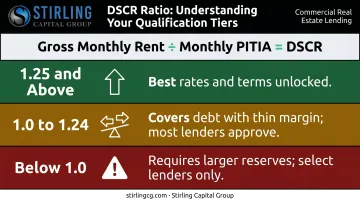
Gross Monthly Rental Income ÷ Monthly PITIA (Principal, Interest, Taxes, Insurance, and Association dues) = DSCR
A quick example: if a rental property generates $2,500 per month in gross rent and the monthly PITIA is $2,000, the DSCR is 1.25. That means the property produces $1.25 for every $1.00 of debt obligation.
Here's how lenders interpret different ratios:
| DSCR Ratio | What It Signals |
|---|---|
| 1.25 and above | Strong cash flow; typically unlocks best rates and terms |
| 1.0 to 1.24 | Property covers debt exactly or with thin margin; most lenders will still approve |
| Below 1.0 | Rent doesn't fully cover debt service; some lenders allow this with larger reserves |
Some lenders — Deephaven, for example — permit ratios as low as 0.75x, though sub-1.0 approvals generally require six months of PITIA reserves and tighter credit standards.
Basic Eligibility
- Property type: Investment properties only — no primary residences
- Minimum credit score: Varies by lender; Griffin Funding reports a minimum of 620 with an average borrower FICO of 729
- Down payment: Generally 20–25%; strong credit scores and higher DSCR ratios can reduce this requirement
- Entity ownership: Many programs support LLC and trust closings
Key Pros of DSCR Loans for Real Estate Investors
The advantages of DSCR loans center on access, flexibility, and scalability — benefits that matter most to investors who don't fit traditional lending criteria.
No Personal Income Verification Required
DSCR loans eliminate the documentation that trips up many investors: W-2s, tax returns, pay stubs, and employer verification. Qualification rests entirely on the subject property's cash flow.
This matters because conventional underwriting creates a structural disadvantage for certain borrower profiles. Fannie Mae requires a two-year history of self-employment income, plus individual and business tax returns. A 2024 Urban Institute report found that self-employed and informal-income households face meaningful mortgage barriers due to documentation mismatches and income volatility.
The practical impact:
- A contractor with heavy business deductions may show low taxable income despite strong actual cash flow
- A portfolio investor with multiple income streams faces complex documentation requirements on each application
- A foreign national buyer without U.S. income history may be categorically excluded from conventional programs — Deephaven's DSCR program explicitly allows foreign nationals, though it requires six months of PITIA reserves
For these borrowers, DSCR financing is often the only path to a competitive loan structure. Not because they can't afford the property, but because conventional income documentation doesn't reflect their real financial position.
No Portfolio Cap — Unlimited Scaling Potential
Fannie Mae and Freddie Mac cap financed 1–4 unit investment properties at 10 per borrower. Once an investor hits that ceiling, conventional financing is off the table regardless of their financial strength.
DSCR lenders evaluate each property on its own cash flow merits. Griffin Funding's DSCR program states no limit on the number of properties, a feature consistent across multiple non-QM DSCR lenders. Portfolio growth becomes a function of deal quality: properties that meet the DSCR threshold get financed; properties that don't get passed on.
For investors building toward double-digit portfolios, the constraint shifts from an arbitrary loan count to whether each property produces sufficient income to qualify independently. That's a meaningful difference for anyone scaling aggressively.
Faster, Streamlined Approval Process
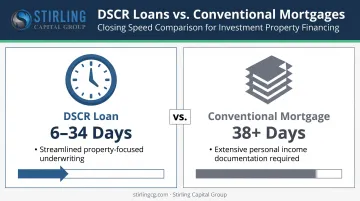
Because underwriting focuses on property income rather than extensive personal financial documentation, DSCR closings move faster than conventional mortgage processes. Griffin Funding reported that DSCR closings averaged 34 days in 2025, with some transactions closing in as few as 6 days.
For context, ICE Mortgage Monitor data from May 2026 put the average closing time across all origination types at 38.2 days. That figure isn't specific to the more document-heavy conventional investment property process, so the gap for those loans is likely wider.
In competitive acquisition markets, a faster close isn't just convenient. It's often the difference between winning a deal and losing it to a cash buyer or a better-capitalized competitor.
Entity-level closing is another practical advantage: most DSCR programs support LLC, corporation, or limited partnership ownership, allowing investors to close into their holding structure directly rather than taking title personally and transferring later.
Key Cons of DSCR Loans to Know Before Applying
These trade-offs are real. Factor them into your return projections before committing to a DSCR structure.
Higher Interest Rates and Upfront Costs
DSCR loans are classified as non-QM (non-qualified mortgage) products. Because lenders operate outside the conventional secondary market, they price in additional risk through higher rates and fees.
As of June 2026, Griffin Funding advertised fixed DSCR rates of 6.125% to 7.5% and ARM rates of 5.125% to 6.125%. Bankrate's investment property rate page showed a national average 30-year fixed investment-property APR of 6.59% around the same period.
The spread between DSCR and conventional investment property rates varies by lender and borrower profile, but DSCR borrowers consistently pay a premium.
Beyond the rate, the full cost picture includes:
- Origination fees
- Underwriting and processing fees
- Buy down your rate by paying higher points upfront — or accept a higher rate with fewer fees
Credit score has a direct effect on pricing. A borrower at 740+ FICO accesses meaningfully better terms than one at 620. If your score is borderline, improving it before applying can meaningfully reduce the long-term cost of the loan.
Run these costs through your cash flow model before committing. A higher rate compresses net cash flow, which directly affects whether the deal still pencils.
Larger Down Payment and Reserve Requirements
Most DSCR programs require 20–25% down, though some lenders offer lower LTVs for borrowers with strong credit and DSCR ratios. Deephaven allows first-time investors up to 80% LTV (20% down) on qualifying transactions, while Griffin notes that borrowers with 740+ FICO may access 15% down in select programs.
Reserve requirements add another layer. Deephaven's lending matrix requires:
- 3 months PITIA in reserves as a standard requirement
- 6 months PITIA for transactions where the DSCR falls below 1.0x or for foreign national borrowers
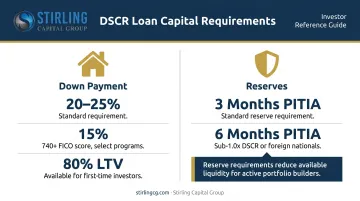
For investors actively deploying capital across multiple acquisitions simultaneously, these reserve requirements reduce available liquidity. If you're scaling quickly, factor the reserve hold into your capital plan.
Vacancy Risk and Prepayment Penalties
Since DSCR qualification depends entirely on rental income, vacancy directly threatens the loan's performance. The U.S. Census reported a 7.3% national rental vacancy rate in Q1 2026 — meaning the risk of income disruption is real and measurable. A property with personal income backing can absorb a vacancy period; a DSCR-only structure cannot.
Vacancy risk isn't the only timing-related constraint to weigh. Prepayment penalties add another layer of exit risk. Most DSCR programs include restriction windows ranging from 1 to 5 years, during which early payoff or refinancing triggers a penalty. The structure varies by lender.
Prepayment penalties can actually work in your favor. Many lenders offer a direct trade-off: accept a prepayment penalty window and receive a lower interest rate. Investors planning long-term holds — who have no intention of selling or refinancing within the penalty window — can use this strategically to reduce their rate and improve cash flow.
The risk falls on investors who need exit flexibility within the first few years. Review the specific penalty structure before signing.
Who Is a DSCR Loan Best (and Worst) For?
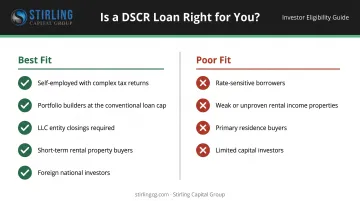
DSCR loans deliver the most value for:
- Self-employed investors with complex tax structures whose taxable income understates actual cash flow
- Portfolio builders who've reached or are approaching the 10-property conventional loan cap
- Investors closing into LLCs or other business entities for liability protection
- Buyers of short-term rentals (Airbnb/VRBO) where traditional lenders struggle with income documentation
- Foreign national buyers without U.S. income history
DSCR loans are a poor fit for:
- Investors seeking the absolute lowest interest rate available (conventional loans typically win on rate)
- Buyers of properties with weak, seasonal, or unproven rental income
- Anyone purchasing a primary residence — DSCR is strictly for investment properties
- Borrowers with very limited capital for a 20%+ down payment and reserve requirements
Once you've identified which category you fall into, run the numbers before submitting an application. Divide projected gross monthly rent by the estimated PITIA to get your DSCR. If the result comes in below 1.0x, most lenders will require additional reserves or decline the application outright. Catching a weak ratio early protects your credit inquiry count and lets you address the shortfall — through higher rent projections, a larger down payment, or a different property — before you're sitting across from an underwriter.
How to Get the Most Value from a DSCR Loan
DSCR loan performance improves when investors approach it with structure, not just availability:
- Target properties with documentable rental income — appraisers will use a rent schedule or comparable market rents; properties with established lease history are easier to underwrite
- Maintain a credit score that unlocks competitive terms — 720+ puts you in a significantly better rate tier than 660
- Structure the deal cleanly — know your LTV, have your reserves ready, and have your entity documents prepared if closing in an LLC
- Compare programs across multiple lenders — DSCR thresholds, minimum credit scores, prepayment structures, eligible property types, and fee structures vary considerably from one lender to another
That last point is where lender access matters most. Stirling Capital Group works with over sixty private lending sources, including specialists in single-family rentals, multifamily, and new construction rental projects, rather than applying one-size-fits-all underwriting to every deal.
Different lenders carry different risk tolerances, DSCR thresholds, and advance rate structures. The right lender for one deal may be entirely wrong for another — and identifying that match early is what moves a deal forward.
Each property that qualifies and performs generates equity that can be deployed into the next acquisition. That compounding effect is what separates investors who close one deal from those who build a portfolio.
Frequently Asked Questions
Do DSCR loans close faster?
Generally, yes. Because underwriting focuses on property income rather than personal financial documentation, DSCR closings typically move faster than conventional investment property mortgages. Griffin Funding reported an average of 34 days in 2025. Actual timelines depend on documentation completeness, the property appraisal, and the lender's pipeline at the time of application.
Can I live in a home bought with a DSCR loan?
No. DSCR loans are strictly for investment properties and cannot be used to purchase a primary residence. Lender matrices explicitly restrict these programs to non-owner-occupied properties. Borrowers planning to live in the property will need a different loan product.
Can you pay off a DSCR loan early?
Early payoff is possible, but most DSCR programs include prepayment penalty windows ranging from 1 to 5 years. Paying off the loan within that window triggers a penalty. Review your loan agreement before committing. Accepting a penalty window often comes with a lower interest rate as a trade-off.
What is a good DSCR ratio to qualify for a loan?
Most lenders require a minimum DSCR of 1.0 to 1.25x. Ratios above 1.25x typically unlock better rates and more favorable terms. A ratio below 1.0x means the property's rental income doesn't fully cover debt obligations — some lenders allow this with larger cash reserves, but most treat it as elevated risk.
How much down payment is required for a DSCR loan?
Most programs require 20–25% down, though borrowers with strong profiles (740+ FICO, high DSCR) may qualify for lower thresholds in select programs. Conventional investment loans can go as low as 15% down, but those come with loan-level price adjustments that affect your rate.
Are DSCR loans available to first-time real estate investors?
Yes. DSCR eligibility is based on property income performance, credit, and liquidity — not investment experience. Stirling Capital Group's lending network serves both first-time rental owners and seasoned portfolio operators. Down payment, reserve, and DSCR ratio requirements apply regardless of experience level.