Commercial fleet financing solves this by spreading acquisition costs over time, so businesses can keep cash working in operations while still adding vehicles. It comes in several forms — equipment loans, leases, SBA programs, and lines of credit — each with different tradeoffs.
This guide covers what commercial fleet financing is, the main types available, the honest pros and cons, how to qualify, and a step-by-step application process.
Key Takeaways
- Fleet financing preserves working capital while allowing businesses to acquire vehicles they couldn't purchase outright
- Equipment loans build ownership equity; leases offer lower payments with flexible options at term end
- Traditional lenders typically require a 670+ personal credit score and 1-2 years in business
- Non-bank and specialty lenders serve businesses that don't meet standard bank criteria — often with faster approvals
- Always compare APR, fees, and prepayment penalties across at least 2-3 lenders before signing
What Is Commercial Fleet Financing?
Commercial fleet financing is a category of business lending that funds the acquisition, expansion, or replacement of vehicles used for commercial purposes — delivery vans, semi-trucks, box trucks, flatbed trailers, construction vehicles, and specialty fleet assets.
Unlike a personal auto loan, these transactions are underwritten differently. The vehicles serve a revenue-generating function, so lenders review business credit, cash flow, tax returns, and financial statements — not just personal credit history.
Who Uses It
Businesses across a wide range of industries rely on fleet financing:
- Trucking and logistics companies
- Construction and heavy equipment operators
- Landscaping and HVAC contractors
- Food distribution and delivery services
- Any business where vehicles are core operating assets
Both sole proprietors and corporations can access these programs. The key distinction from paying cash is liquidity: financing lets businesses deploy capital elsewhere — on payroll, inventory, or growth — while still acquiring the vehicles they need.
According to the Equipment Leasing & Finance Foundation, 82% of equipment end-users used financing for equipment acquisitions in 2023, and transportation equipment represented 23.2% of equipment financing new business volume in 2024 — the largest single category.
Types of Commercial Fleet Financing Options
Equipment Financing (Loans)
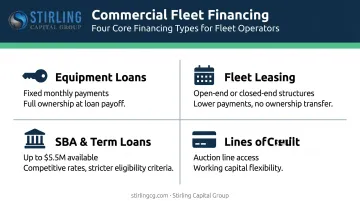
The most common structure: a lender funds the vehicle purchase directly, often paying the dealer, and the business repays through fixed monthly installments over a set term. At payoff, the business owns the vehicles outright.
Ownership matters for tax purposes. For tax years beginning in 2025, the IRS allows a Section 179 deduction of up to $2,500,000 on qualifying business equipment and vehicles, with a phase-out beginning above $4,000,000. Bonus depreciation for qualified property placed in service in 2025 may also apply — consult a tax advisor to confirm what applies to your specific vehicles and situation.
Fleet Leasing
Leasing means paying for the use of vehicles over a contract term without ownership at the end. Monthly payments are typically lower than a purchase loan, which appeals to businesses that want to upgrade their fleet regularly or prefer to keep assets off the balance sheet.
Two common structures:
- Open-end leases — More flexibility, no fixed mileage caps, but the business assumes residual value risk at the end of the term
- Closed-end leases — Fixed terms with defined mileage allowances; return conditions are set upfront, with potential penalties for overages
SBA Loans and Business Term Loans
SBA 7(a) loans (up to $5M) and SBA CDC/504 loans (up to $5.5M) can be used for commercial equipment and vehicle purchases in certain structures. The 504 program is particularly relevant for heavy-duty vehicles and long-lived equipment requiring a useful life of at least 10 years.
Business term loans from banks and credit unions also work for fleet acquisitions and tend to offer competitive rates for well-qualified borrowers. The tradeoff is stricter eligibility requirements and longer processing times compared to non-bank lenders.
Auction Lines of Credit and Working Capital Lines
Two flexible credit tools serve different fleet funding needs:
- Auction lines of credit — Let fleet managers buy vehicles at commercial auctions up to a pre-approved limit, useful for operators who source vehicles as deals come up rather than through dealers
- Working capital lines — Cover fleet-adjacent expenses like fuel, maintenance, and insurance, even when the primary purpose isn't vehicle acquisition
Pros of Commercial Fleet Financing
Fleet financing offers meaningful advantages for businesses of nearly any size. Here's what makes it worth considering:
Preserves Cash Flow Buying even a modest fleet outright can tie up hundreds of thousands of dollars. At $48,400 per van, a 10-vehicle fleet costs nearly $500,000 before fees or upfitting. Financing spreads that cost over time. 62% of equipment finance end-users cite cash flow optimization as their primary reason for choosing financing over a cash purchase.
Increases Purchasing Power Financing lets businesses acquire more vehicles — or better-specified ones — than cash on hand would allow. That additional capacity can translate directly into larger contracts, more delivery volume, or faster market expansion. Pre-approval also lets operators move quickly in competitive inventory markets.
Builds Business Credit Consistent repayment on a commercial fleet loan establishes business credit history and strengthens scores over time — improving access to future financing at better terms. Paying cash provides no credit-building benefit at all.
Potential Tax Advantages Financed vehicles may qualify for Section 179 expensing or bonus depreciation, allowing businesses to deduct a significant portion of the purchase cost in the year of acquisition. Leased vehicles may allow deductions on monthly payments. Tax treatment varies by situation — a CPA should confirm what applies.
Flexible Vehicle and Program Coverage Fleet financing programs cover light-duty trucks, semis, trailers, and specialty vehicles. Many non-bank and specialty lenders — including those in Stirling Capital Group's network of 60+ private lending sources — do not impose the same age restrictions on vehicles or rigid time-in-business requirements that traditional banks use.
In short, financing frees up capital, expands capacity, and opens doors that a single lump-sum purchase simply can't.
Cons of Commercial Fleet Financing
Total Cost Exceeds the Purchase Price Interest is real money. A $100,000 truck financed at 7% over 60 months costs approximately $118,000 in total payments — roughly $18,000 more than the purchase price, before any fees. The longer the term and the higher the rate, the wider that gap becomes.
Qualification Challenges for Newer Businesses
Traditional bank lenders typically require:
- Personal credit score of 670+ (some require higher)
- 1-2 years in business at minimum
- Documented annual revenue
- Down payments of 10-20% for lower-credit applicants
Banks like Bank of America require minimum 4 years in business for their business auto loan programs and restrict eligible vehicles to those under 5 years old with less than 75,000 miles. Businesses with limited history or credit challenges may not qualify at all — or may face rates that make the economics difficult.
Non-bank and specialty lenders fill this gap by applying different underwriting criteria — collateral strength, contract backlog, and transaction structure — rather than hard credit score cutoffs. Stirling Capital Group, for example, works with 60+ private lending sources and can structure deals that traditional banks typically decline.
Rate and Fee Transparency Varies Some lenders don't disclose APR or full fee structures upfront. Before signing anything, request a complete breakdown of:
- Annual Percentage Rate (APR)
- Origination fees
- Prepayment penalties
- Insurance requirements
Compare at least 2-3 offers. Navy Federal, for example, explicitly offers no prepayment penalties on their business vehicle loans — not every lender does.
Depreciation and Long-Term Commitment Risk Commercial vehicles lose value over time — used Class 8 truck retail prices fell over 20% year-over-year in 2024. A business locked into a 60-month loan on a heavily used truck may eventually owe more than the vehicle is worth, especially if operating costs rise and trade-in value falls. Early payoff penalties on some loans can limit options if business needs shift.
How to Qualify for Commercial Fleet Financing
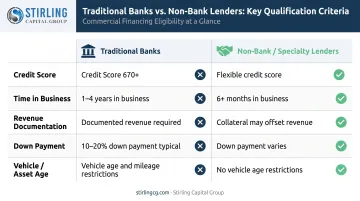
Lenders evaluate several factors when reviewing a fleet financing application:
| Factor | Traditional Banks | Non-Bank/Specialty Lenders |
|---|---|---|
| Personal credit score | 670+ preferred | More flexible; varies by lender |
| Time in business | 1-4 years minimum | Some accept 6 months+ |
| Annual revenue | Documented, consistent | May weigh collateral over revenue |
| Down payment | 0% for strong credit; 10-20% typical | Varies; strong collateral can offset |
| Vehicle restrictions | Often age/mileage limits | Many have no vehicle age restrictions |
What to Prepare Before Applying
Most lenders will ask for:
- Business and personal tax returns (typically 2 years)
- Business bank statements (3-6 months)
- Business license or formation documents
- Vehicle details: VIN, purchase price, dealer information
- Proof of insurance
Having these documents ready before you apply cuts down review time and reduces back-and-forth with the lender.
How to Apply for Commercial Fleet Financing
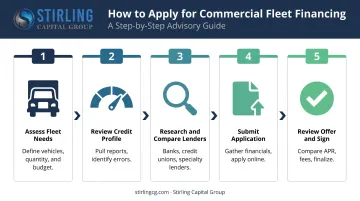
Step 1: Assess Your Fleet Needs and Budget
Define how many vehicles you need, what type (light-duty, heavy-duty, specialty), new vs. used, and over what time horizon. Before approaching any lender, calculate the total anticipated acquisition cost. This determines the loan amount and term structure for your cash flow and prevents over-borrowing.
Key decisions to nail down first:
- Vehicle type and quantity
- New vs. used preference
- Ownership timeline (lease vs. buy)
- Maximum monthly payment your cash flow supports
Step 2: Review Your Credit and Financial Profile
Pull both your personal and business credit reports before applying. Identify any errors and dispute them before submitting anything. Knowing your credit position sets realistic expectations — if your score is below 640, a traditional bank may not be the right starting point, and that's worth confirming before you invest time in a lengthy application.
Quick credit checklist:
- Personal credit report (all three bureaus)
- Business credit profile (Dun & Bradstreet, Experian Business)
- Outstanding liens or judgments that could affect approval
- Time in business and annual revenue figures
Step 3: Research and Compare Lenders
Consider multiple lender types: traditional banks, credit unions, SBA-approved lenders, and specialty non-bank commercial lenders. Each has different credit criteria, processing timelines, and pricing structures.
If your business doesn't fit a standard bank credit box, a commercial finance consultant like Stirling Capital Group can help. With access to over 60 private lending sources and authorization to pre-qualify and pre-underwrite across multiple lenders, they can match your profile to the right lender faster — and with better odds of approval.
Step 4: Gather Documentation and Submit
Complete the lender's application (often online), attach your financial documents, and provide vehicle details. Many non-bank lenders offer streamlined digital applications with soft credit pulls that don't affect your score. Some specialty lenders can issue credit decisions in 24 hours; traditional bank reviews typically take 7-10 business days.
Step 5: Review the Offer and Finalize
Before signing, compare:
- Loan amount and monthly payment
- Interest rate (APR or factor rate)
- Repayment term
- Prepayment penalties
- Insurance requirements and any origination fees
Compare at least 2-3 offers side by side. Once you accept and sign, funding from non-bank lenders can arrive within 24-72 hours depending on the lender.
Frequently Asked Questions
What is commercial fleet financing?
Commercial fleet financing is a business lending category used to fund the purchase or lease of vehicles for commercial operations. Unlike personal auto loans, the vehicles serve as collateral and underwriting is structured around business purpose and creditworthiness.
Is commercial fleet financing legitimate?
Yes. It's a well-established form of business lending offered by banks, credit unions, SBA-approved lenders, and specialty finance companies. Vet any lender through BBB ratings and verify full fee disclosure upfront — never sign without a complete APR breakdown.
How much is a monthly payment on a $70,000 truck?
Using published business vehicle APRs and a 60-month term, estimated monthly payments range from approximately $1,292 at 4.09% APR to $1,399 at 7.39% APR. These figures exclude taxes, fees, down payment, and insurance — actual payments vary based on your lender, credit profile, and negotiated terms.
What credit score do you need for commercial fleet financing?
Most traditional lenders prefer a minimum personal credit score of 670+, along with a business credit score of 80+ (on the PAYDEX scale). Non-bank and specialty lenders often work with lower scores, typically requiring a larger down payment or charging higher rates to offset added risk.
What types of vehicles qualify for commercial fleet financing?
Common qualifying vehicles include delivery vans, semi-trucks, box trucks, flatbed trailers, work trucks, tow trucks, and construction vehicles. Many specialty and non-bank lenders also finance used vehicles without strict age or mileage restrictions.
Can a startup or newer business get commercial fleet financing?
Newer businesses face more scrutiny but can still qualify. Alternative and private lenders often have more flexible time-in-business requirements and may approve applications based on strong collateral, a solid business plan, or a sufficient down payment — even without a multi-year operating history.