

Introduction
Most business owners eventually hit a ceiling with their senior lender. The bank will go to a certain point — and no further. Raising equity to cover the gap means giving up ownership, diluting control, and sharing upside with outside investors. For many businesses, neither option is acceptable.
That gap in the middle of the capital stack is where mezzanine financing operates.
Mezzanine financing is active across acquisitions, leveraged buyouts, real estate development, and corporate expansions — often filling gaps ranging from a few million to well over $50 million. Yet many business owners assume it's a last resort or a tool reserved for large corporations. It's neither. This guide breaks down how mezzanine financing is structured, how it works in practice, where it's deployed, and what to consider before pursuing it.
Key Takeaways
- Mezzanine financing sits between senior debt and equity in the capital stack, combining features of both
- Typically structured as subordinated debt or preferred equity, interest-only with a bullet maturity of five to eight years
- Common uses include acquisitions, management buyouts, real estate development, and ownership transitions
- Priced higher than senior debt but less dilutive than equity, earning the nickname "expensive debt or cheap equity"
- Best suited to established businesses with consistent cash flow, not early-stage companies
What Is Mezzanine Financing?
Mezzanine financing is a hybrid capital instrument that sits between senior secured debt and common equity in a company's capital structure. The World Economic Forum defines it as subordinated capital positioned between senior debt and equity, typically taking the form of unsecured debt or preferred equity. The name derives from the Latin medianus — "middle" — which describes exactly where it sits in the capital stack.
Why It Exists
Senior lenders will only fund a portion of a business's total capital need. Raising equity to cover the remainder is expensive and dilutive. Mezzanine fills that gap, giving businesses access to capital they couldn't otherwise reach without surrendering meaningful ownership.
To use it well, you need to know what it isn't:
- Ranks below senior debt in repayment priority — not a senior loan
- Requires repayment and carries an interest coupon — not pure equity
- Structured as a long-term subordinated instrument — not a short-term bridge loan
Two Primary Forms
| Structure | Risk Profile | Key Characteristic |
|---|---|---|
| Subordinated debt | Below senior debt, above equity — often unsecured | Debt-like with equity-level risk and returns |
| Preferred equity | More equity-like, below all debt | Distributions and control rights depend on deal terms |
Who It's For
Mezzanine financing suits established companies with demonstrated revenue and cash flow — not pre-revenue startups. The CDFA specifies that borrowers must show proven cash flow, solid management, expanding market scope, and an established business plan. Typically, these are businesses that have already maximized their senior debt capacity and need incremental capital to execute a growth event.
How Does Mezzanine Financing Work?
Mezzanine financing operates within a defined capital hierarchy, where each layer carries distinct rights, risks, and costs.
Entering the Capital Stack
The stack works as follows, and the order matters most in a default scenario:
- Senior secured debt: first repayment priority, lowest risk, typically collateralized
- Mezzanine debt or preferred equity: second priority, higher risk, often unsecured
- Common equity: last repayment, highest risk and highest upside
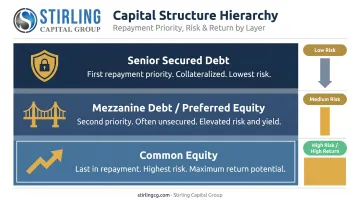
PGIM describes mezzanine as junior capital subordinated to senior debt in both structure and repayment rights. In a default scenario, mezzanine lenders only receive repayment after all senior debt obligations are fully satisfied. Some structures use blanket subordination — blocking all mezzanine payments until senior debt is repaid — while others use springing subordination, which permits interest payments until a default or covenant breach occurs.
That subordinate position is precisely why mezzanine carries higher interest rates. The risk is real, and lenders price accordingly.
Payment Structure and Terms
That pricing takes a specific form. Mezzanine compensation typically combines three elements:
- Cash interest — periodic coupon payments during the loan term
- PIK (payment-in-kind) interest — interest that accrues to the principal rather than paid in cash, providing near-term cash flow relief while compounding the final payoff amount
- Equity kicker — warrants or equity participation rights, often representing 5% to 20% of outstanding equity, allowing lenders to achieve target returns without placing unsustainable cash burdens on the borrower
On repayment structure, the terms are notably borrower-friendly during the loan term. There is typically no scheduled principal amortization — only interest payments — until a bullet maturity date, usually five to eight years out. This patient capital structure gives businesses time to grow and generate the cash flow needed to refinance the mezzanine at a lower rate.
Working with a Mezzanine Lender
Since most mezzanine debt is unsecured, lenders focus primarily on cash flow rather than collateral. Underwriters assess:
- EBITDA and cash flow reliability
- Management track record
- The specific transaction being financed
- Ability to service interest obligations through the term
Mezzanine deals take time. Structuring typically requires three to six months, involving coordination between multiple capital providers — a senior lender and a mezzanine provider who must agree on intercreditor terms.
Working with an experienced intermediary matters here. Stirling Capital Group, for example, draws on a portfolio of over sixty private lending sources — including equity capital partners — and pre-qualifies and pre-underwrites deals before approaching lenders, which accelerates the matching process considerably.
Where Mezzanine Financing Is Used
Mezzanine is most effective when a specific transaction is driving the capital need and a clear repayment thesis exists. The five scenarios below account for the majority of mezzanine financing activity.
Acquisitions and Leveraged Buyouts
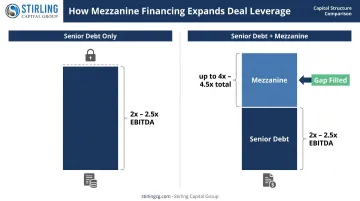
Mezzanine bridges the gap between what a senior lender will extend and the total purchase price. CAIA notes that senior lenders often cap loans at 2x to 2.5x EBITDA, while mezzanine can expand total leverage to 4x to 4.5x EBITDA — enabling buyers to close deals that senior financing alone couldn't support.
Management and Shareholder Buyouts
Management teams can use mezzanine to acquire or consolidate ownership stakes without bringing in a private equity firm to take a majority interest. This preserves leadership continuity and keeps control within the existing team.
Growth Capital and Expansion
Companies planning significant capital expenditures, facility construction, or geographic expansion use mezzanine when the investment exceeds senior borrowing capacity — particularly when future cash flows from that investment justify the financing cost.
Real Estate Development
Property developers use mezzanine to reduce the equity deposit required by a senior construction or mortgage lender, freeing capital to allocate across multiple projects. In real estate, mezzanine can supply 10% to 40% of a project's capital structure, typically secured by a second lien on the property or a pledge of equity interests in the property-owning entity.
For complex commercial real estate transactions — where senior debt reaches 80% LTV and subordinate mezzanine extends leverage to 85% LTV — Stirling Capital Group's lender network includes sources that specifically work within these layered capital stacks.
Business Recapitalizations and Ownership Transitions
Mezzanine enables balance sheet restructuring, refinancing of existing debt, and ownership recapitalizations — including family business succession scenarios — where issuing common equity would be impractical or undesirable.
Pros and Cons of Mezzanine Financing
Advantages
- No principal amortization — interest-only structure preserves operating cash flow throughout the term
- Less dilutive than equity — warrants may represent 5% to 20% of equity, far less than a full equity raise
- Owners retain control — no majority equity sale required; existing management typically keeps board authority
- Tax treatment — mezzanine interest is generally treated as business interest expense, though deductibility can be limited by Section 163(j) of the tax code depending on the borrower's adjusted taxable income
- Longer maturity — five to eight years gives businesses time to execute the financed growth event before facing repayment pressure
Disadvantages
- Higher cost than senior debt — CAIA benchmarks total mezzanine returns at 12% to 17%, with stated coupon rates typically in the 10% to 14% range
- Restrictive covenants — lenders may limit additional borrowing, require financial ratio compliance, or need approval before acquisitions, dividend payments, or management changes
- Governance rights — lenders may negotiate board observation rights or approval authority over key decisions; terms are deal-specific
- PIK compounds the exit burden — while PIK interest relieves near-term cash pressure, it increases the principal balance that must be repaid or refinanced at maturity
- Structuring complexity — coordinating multiple capital providers takes time; expect three to six months to close
Is Mezzanine Right for Your Situation?
Four questions can quickly reveal whether mezzanine is the right fit:
- Can your business reliably service interest payments throughout the loan term, even in a slower quarter?
- Does the funded opportunity generate sufficient return to justify an all-in cost of 12% to 17%?
- Have you exhausted other options — senior debt extension, preferred equity, or an equity partner?
- Can you cover the balloon payment at maturity, either through refinancing or a liquidity event?
If you answered yes across the board, mezzanine financing is worth pursuing — but the structure you negotiate and the lender you choose will determine whether it works in your favor.
Conclusion
Mezzanine financing is a deliberate capital tool — one that experienced borrowers use to move past senior debt limits without surrendering ownership. Understanding its structure lets business owners evaluate it on its actual merits: a patient, flexible capital layer with a defined cost and a defined purpose.
Accessing and structuring mezzanine financing depends on having the right lending relationships and deal expertise. Stirling Capital Group works with a portfolio of over sixty private lending sources across debt and equity capital, helping business owners and developers determine whether mezzanine is the right fit and connect with the appropriate capital partner for their transaction.
For a free consultation, contact the team at 614-470-4716 or info@stirlingcg.com.
Frequently Asked Questions
What is mezzanine financing?
Mezzanine financing is a hybrid capital instrument that sits between senior debt and equity in a company's capital structure. It provides businesses with additional capital beyond what senior lenders will extend, without requiring the equity dilution of a full equity raise.
What is an example of mezzanine financing?
A business acquiring a competitor uses senior debt to cover 70% of the purchase price, then closes the gap with a mezzanine loan at a higher interest rate. No principal payments are due until maturity — typically five to eight years out — giving the company time to integrate before repayment begins.
What are the risks of mezzanine financing?
Key risks include higher interest costs than senior debt, restrictive covenants, subordinate repayment priority in default, and PIK interest that compounds the final payoff. Deals also take three to six months to structure and require experienced coordination.
How does mezzanine financing differ from senior debt?
Senior debt is repaid first in a default and is typically secured by collateral. Mezzanine is repaid second, is often unsecured, carries a higher interest rate, and offers more structural flexibility — no amortization and longer maturities than most senior loans.
What types of businesses typically use mezzanine financing?
Established middle-market companies with proven cash flow, solid operating history, and a specific transaction goal that exceeds their senior debt capacity. Early-stage startups without stable earnings rarely qualify.
What are typical interest rates for mezzanine financing?
CAIA benchmarks all-in corporate mezzanine target returns at 12% to 17%, with stated coupon rates typically between 10% and 14%. Total returns exceed the coupon once PIK interest, fees, and equity warrants are included. Real estate mezzanine pricing varies based on loan-to-value, development risk, and sponsor strength.